
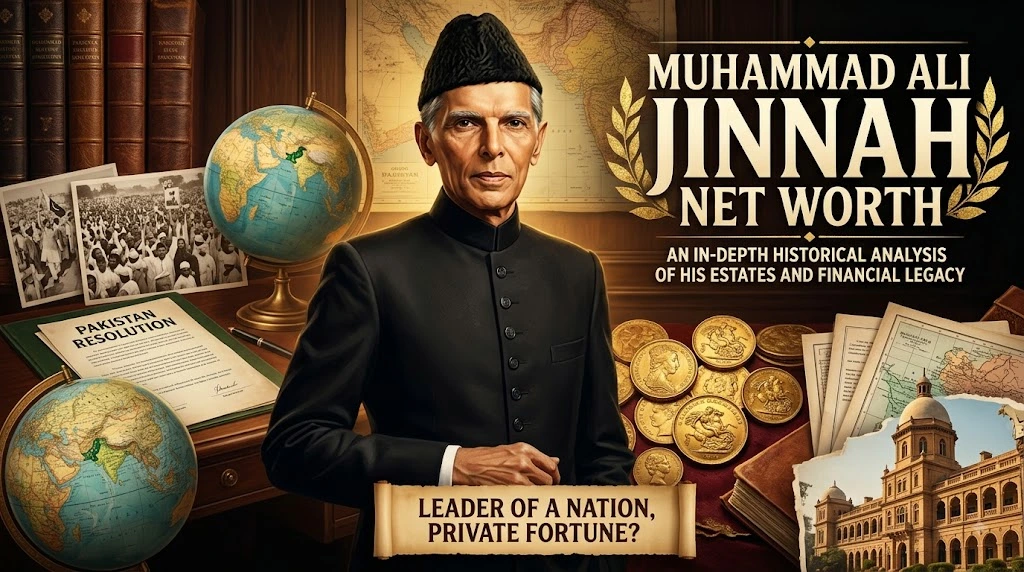
Imagine a quiet evening in Bombay, when a determined lawyer walks into a courtroom dressed in his famous tailored suit. His name is Muhammad Ali Jinnah, a man whose calm voice, sharp arguments, and unwavering discipline would eventually change the course of South Asian history. Long before he became the founder of Pakistan, Jinnah had already built a successful career as one of the most respected lawyers of his time.
His journey from a young barrister to the leader of a historic political movement also raises an interesting question: what was Muhammad Ali Jinnah net worth? Unlike modern public figures, Jinnah did not leave behind detailed financial records designed for public estimates. His wealth came largely from his legal career, property, investments, and professional success rather than political office.
In this article, we’ll explore Jinnah’s financial background, career earnings, properties, lifestyle, and the historical evidence that helps us understand his wealth. More importantly, we’ll look beyond a single number and discover how his financial success supported the remarkable journey of the man who became Pakistan’s first Governor-General.
- Muhammad Ali Jinnah Net Worth in Rupees
- What Was Muhammad Ali Jinnah’s Net Worth in Rupees?
- Muhammad Ali Jinnah Net Worth at the Time of His Death
- How Much Was Muhammad Ali Jinnah Worth in Pakistani Rupees?
- Muhammad Ali Jinnah Wealth and Assets
- Muhammad Ali Jinnah Income Sources and Earnings
- What Were Muhammad Ali Jinnah’s Main Sources of Income?
- Muhammad Ali Jinnah Property and Real Estate
- Muhammad Ali Jinnah House and Personal Assets
- Muhammad Ali Jinnah Salary as Governor-General of Pakistan
- Muhammad Ali Jinnah Legal Career and Income
- How Did Muhammad Ali Jinnah Build His Wealth?
- Muhammad Ali Jinnah Business Investments and Financial Life
- Muhammad Ali Jinnah Net Worth Compared With Other Leaders
- Muhammad Ali Jinnah Wealth in Today’s Pakistani Rupees
- What Would Muhammad Ali Jinnah’s Net Worth Be Worth Today?
- Muhammad Ali Jinnah Assets, Property, and Investments
- Was Muhammad Ali Jinnah a Rich Man Before Pakistan?
- Muhammad Ali Jinnah Financial History and Net Worth
- Muhammad Ali Jinnah Net Worth in Rupees: Complete Overview
Who Is Muhammad Ali Jinnah?
Muhammad Ali Jinnah was born on December 25, 1876, in Karachi. He studied at the Sindh Madrassat-ul-Islam and Christian Missionary Society High School before traveling to England to study law.
Jinnah joined Lincoln’s Inn in London in 1893 and was called to the Bar in 1896. After returning to India, he established himself as a lawyer in Bombay. Pakistan’s government describes him as a highly successful lawyer who rose to prominence through his legal ability and determination.
His legal career was the foundation of his personal wealth. Jinnah was not born into the kind of enormous fortune that some historical rulers or industrial families possessed. Instead, he built his financial position through professional income, investments, and property.
Jinnah later became deeply involved in politics. He served as a leader of the All-India Muslim League and played a central role in the political movement that led to the creation of Pakistan.
Pakistan became independent on August 14, 1947. Jinnah then became the country’s first Governor-General, serving from August 15, 1947, until his death on September 11, 1948.
His political career changed his public role, but it is important to separate his political position from his personal wealth. Jinnah’s fortune was largely built before Pakistan’s independence through his legal career and private investments.
He was known for living well, wearing expensive clothing, and maintaining large homes. Historical accounts also describe his residence in London and his properties in Bombay and New Delhi. At the same time, accounts of his personal habits describe him as careful with money despite his affluent lifestyle.
This combination makes Jinnah’s financial story unusual. He was wealthy by the standards of his time, but there is no dependable evidence that allows historians to convert his entire estate into one exact modern net worth figure.
Income and Salary
The biggest source of Jinnah’s personal income was his legal career.
Jinnah became one of the most respected lawyers in Bombay. His reputation allowed him to charge substantial professional fees. According to a historical account based on Stanley Wolpert’s work, Jinnah was reportedly earning around Rs. 40,000 per month from legal practice alone by the early 1930s.
That figure needs context. Rs. 40,000 in the early 1930s cannot simply be converted into modern Pakistani rupees by multiplying it with a currency exchange rate. The purchasing power of money was very different, and the economic structure of British India was not the same as today’s economy.
Still, the figure clearly shows that Jinnah was among the highest-earning professionals of his era.
His income also came from investments and property. Historical material describes him as a private investor who purchased valuable real estate. His properties included residences in Bombay, London, and New Delhi.
One of his best-known properties was his large home at Malabar Hill in Bombay, now Mumbai. Jinnah had the property built in the 1930s. Historical records also show that he negotiated over the possible sale of the property in 1944. The National Archives of Pakistan collection includes correspondence concerning the property and Jinnah’s interest in its value.
Jinnah’s income changed after he became Governor-General of Pakistan.
A commonly repeated claim says that he accepted only one rupee as his Governor-General salary. However, historical salary records tell a different story. A report citing Jinnah’s official pay records states that his monthly salary was Rs. 10,416 and 10 annas.
His salary was also subject to taxes. Reports based on the pay records state that income tax and super tax were deducted from his salary.
This matters when discussing Jinnah’s net worth because his Governor-General salary was only one part of his financial picture. His professional career before independence was much more important in building his wealth.
Another important point is that Jinnah’s political work was not the same as a modern business career. He did not become wealthy by owning a large company or by collecting a political salary for decades. Most of the documented wealth came from his work as a lawyer and from investments made during his lifetime.
Table of Yearly Earnings and Roles
Exact annual income figures for every year of Jinnah’s life are not available in reliable public records. Therefore, it would be misleading to create a table with invented numbers.
The table below uses historical information that can reasonably be discussed. Where a precise figure is unavailable, it is marked accordingly rather than guessed.
PeriodMain RoleKnown or Reported Income InformationMain Financial Source1896–1900sBombay lawyerNo reliable annual figure availableLegal practice1910sSenior lawyer and politicianExact annual income not publicly establishedLegal fees and investments1920sLeading lawyer and political leaderExact annual income not publicly establishedLegal practice and investmentsEarly 1930sSenior Bombay lawyerReportedly around Rs. 40,000 per month at the BarLegal practice1930sLawyer, politician, property ownerExact annual total unavailableLegal work, property, securities1940–1946Muslim League leader and lawyerExact annual total unavailableLegal work and investments1947Founder of Pakistan and Governor-GeneralOfficial Governor-General salary was about Rs. 10,416 per monthGovernment salary and existing assets1948Governor-General of PakistanAbout Rs. 10,416 per month before applicable deductionsGovernment salary and existing assets
The reported Rs. 40,000 monthly legal income should be treated as a historical estimate rather than a complete audited income statement. It tells us that Jinnah was a highly successful lawyer, but it does not tell us exactly how much he saved or invested.
Likewise, his Governor-General salary does not represent his total wealth. By the time he became Governor-General, he had already spent decades building his legal career and acquiring assets.
Net Worth in 2026
There is no verified official figure for Muhammad Ali Jinnah’s net worth in 2026.
That answer may seem less exciting than a large dollar estimate, but it is the most accurate way to approach the subject. Jinnah died in 1948, so he does not have a current personal net worth in the same sense as a living celebrity or businessperson.
When websites publish a modern figure for Jinnah’s “net worth,” they are usually trying to estimate the value of his historical estate or certain properties. Those calculations can vary dramatically depending on which assets are included and how historical values are converted into today’s money.
One example is Jinnah House at Malabar Hill. A 2017 India Today report cited a valuation of about $400 million for the 2.5-acre property.
However, that figure should not be treated as Muhammad Ali Jinnah’s personal net worth. It is a reported valuation of one property. A person’s net worth would also have to consider other real estate, investments, bank accounts, personal possessions, liabilities, and the ownership status of each asset.
Jinnah’s own will gives us a much better historical picture.
His will, written in 1939, stated that shares, stocks, securities, and current accounts held in his sister Fatima Jinnah’s name had been given to her as gifts during his lifetime. He also left Fatima his Malabar Hill home, including its land, furniture, silver, and motor cars.
The will also provided financial support for his siblings. Fatima Jinnah was to receive Rs. 2,000 per month during her lifetime, while other siblings were assigned smaller monthly payments.
Jinnah also left money to educational institutions. His will included a Rs. 25,000 gift to Anjuman-i-Islam School in Bombay, another Rs. 25,000 for the Arabic College of Delhi, and Rs. 50,000 for the University of Bombay, although the university did not accept the donation under the proposed conditions.
These details demonstrate that Jinnah had substantial assets. However, they still don’t provide a complete final balance sheet.
Therefore, the safest conclusion for a 2026 search is this:
Muhammad Ali Jinnah was a wealthy and financially successful man by the standards of British India, but his exact net worth cannot be established from reliable historical records.
Any exact modern dollar amount should be labeled as an estimate, not a confirmed fact.
How Muhammad Ali Jinnah Makes Money

Muhammad Ali Jinnah’s wealth came from several connected sources rather than one business empire.
Legal Career
His legal career was the foundation of his finances.
After returning from England, Jinnah developed a strong reputation in Bombay’s legal community. His skill in constitutional and commercial matters helped him become one of the leading lawyers of his generation.
The reported Rs. 40,000 monthly income in the early 1930s illustrates how successful his practice had become.
This professional income gave him the freedom to invest and maintain expensive properties.
Property Investments
Real estate was another important part of Jinnah’s financial life.
He owned several significant homes, including the famous Malabar Hill residence in Bombay. He also owned property in New Delhi and had a home in London. Historical accounts describe these properties as substantial and valuable.
The 1944 correspondence preserved by the National Archives of Pakistan shows that Jinnah was involved in negotiations concerning his Bombay property.
This suggests that property was not simply a lifestyle expense for him. It was also part of his overall financial planning.
Shares and Securities
Jinnah’s will provides direct evidence that securities and financial accounts formed part of his assets.
The will referred to “shares, stocks & securities” and current accounts. It also stated that certain assets in Fatima Jinnah’s name had already been given to her as gifts during his lifetime.
This is important because it shows that his wealth was not limited to houses and cash.
Governor-General Salary
Jinnah received an official salary after becoming Pakistan’s first Governor-General.
Historical reports based on official records place the monthly salary at about Rs. 10,416 and 10 annas.
Compared with his reported legal income in the early 1930s, this salary was not the main reason he became wealthy. Instead, it was compensation for his final public office.
Personal Possessions
Jinnah’s will also mentioned furniture, silver, and motor cars.
These possessions had financial value, although their value today cannot be used directly to calculate his net worth without detailed records.
His lifestyle also reflected his financial success. Historical accounts describe expensive clothing, large homes, servants, and a comfortable lifestyle. Yet the same sources portray him as careful with money in many areas of daily life.
Why We Cannot Know the Exact Net Worth
The main reason is simple: there is no complete, publicly verified balance sheet showing every asset Jinnah owned at the time of his death.
Modern celebrities often have financial disclosures, company filings, property databases, investment records, or detailed media estimates. Jinnah lived in a very different period.
Financial records from the 1930s and 1940s were also spread across different institutions and jurisdictions. Some assets were held in British India, while others were connected to London or later Pakistan.
There is also a major problem with modern currency conversion.
Suppose someone takes an old rupee amount and converts it directly into U.S. dollars using an exchange rate. That does not tell us the real economic value of the money today. Inflation, wages, land prices, gold prices, purchasing power, and economic growth all produce different results.
Property creates another problem.
Jinnah’s Malabar Hill property is an excellent example. Modern reports have placed extremely high values on the land because Mumbai real estate has become exceptionally expensive. But the modern market value of that property is not the same thing as Jinnah’s personal wealth in 1948.
There is also a question of ownership.
Jinnah’s will stated that some financial assets in Fatima Jinnah’s name were already gifts to her. Therefore, simply adding every asset associated with the Jinnah family could produce an incorrect estimate of Jinnah’s personal estate.
Finally, Jinnah’s estate was distributed according to his will and later became involved in legal and political disputes. His Malabar Hill property, for example, became the subject of later ownership claims and government action.
For all these reasons, a single “Jinnah net worth” number should be treated with caution.
What Seems Most True

The historical evidence supports several clear conclusions.
First, Jinnah was financially successful. His legal career placed him among the highest-earning lawyers in British India. The reported income of about Rs. 40,000 per month in the early 1930s, while not an audited figure for every year, gives a strong indication of his professional success.
Second, he owned valuable property. His Malabar Hill home was a major asset, and he also had other residences and property interests.
Third, his investments extended beyond real estate. His will specifically referred to shares, stocks, securities, and current accounts.
Fourth, his wealth was largely self-made through professional success and investment. Historical accounts describe his affluence as coming from his legal skills and private investments rather than from a large inherited business empire.
Fifth, the exact figure remains unknown.
This last point is the most important for anyone researching Muhammad Ali Jinnah net worth. It is tempting to give readers a precise number in millions or billions of dollars. However, doing so without a reliable estate valuation would create a false sense of accuracy.
A better approach is to say that Jinnah was a wealthy man for his time, with substantial property, financial investments, and professional earnings, while acknowledging that historians do not have a definitive modern net worth figure.
FAQs (Exactly 5 Questions)
1. What was Muhammad Ali Jinnah’s net worth?
There is no reliable official figure for Muhammad Ali Jinnah’s net worth. Historical records show that he was a wealthy lawyer with valuable property, investments, securities, bank accounts, vehicles, and other possessions. His 1939 will provides evidence of these assets, but it does not give one complete modern valuation. Therefore, exact figures published online should be treated as estimates rather than confirmed facts.
2. How did Muhammad Ali Jinnah become wealthy?
Jinnah built most of his wealth through his legal career and investments. He became one of Bombay’s leading lawyers and was reportedly earning around Rs. 40,000 per month at the Bar in the early 1930s. He also invested in property and financial assets. Historical accounts specifically mention his homes, shares, stocks, securities, and other investments.
3. What was Jinnah’s salary as Governor-General?
Historical reports based on official pay records state that Jinnah’s monthly salary as Governor-General was about Rs. 10,416 and 10 annas. His salary was subject to tax deductions. This was his government salary after Pakistan became independent, but it was not the main source of the wealth he had accumulated during his earlier legal career.
4. Did Jinnah own expensive property?
Yes. Jinnah owned several significant properties, including his famous Malabar Hill residence in Bombay. Historical records also connect him with property in New Delhi and London. His will specifically left his Malabar Hill house, land, furniture, silver, and motor cars to his sister Fatima Jinnah.
5. Can Jinnah’s wealth be converted into today’s money?
It can be estimated, but there is no single reliable conversion. Inflation, property prices, exchange rates, and purchasing power all produce different results. A modern valuation of one property, such as Jinnah House, also cannot be treated as his total net worth. For that reason, a precise 2026 dollar figure would be misleading without a complete historical estate valuation.
Conclusion
Muhammad Ali Jinnah’s life was about far more than money. As we explore Muhammad Ali Jinnah net worth, it becomes clear that his financial success was closely connected to his long and respected career as a barrister. Through his legal practice, property ownership, investments, and professional achievements, Jinnah built a comfortable financial position during his lifetime. However, unlike modern celebrities and business leaders, there is no single verified record that can provide an exact figure for his total wealth.
What makes Jinnah’s story especially interesting is how he used his position and resources while pursuing a much larger purpose. He lived with discipline, valued quality, and maintained a successful professional career, yet his historical importance came from his leadership and political vision rather than his fortune.
Therefore, any estimate of Muhammad Ali Jinnah net worth should be treated as an approximation rather than a confirmed fact. His greatest legacy was not the wealth he accumulated, but the country he helped create. Today, his name remains deeply connected with Pakistan’s history, independence, and national identity.